
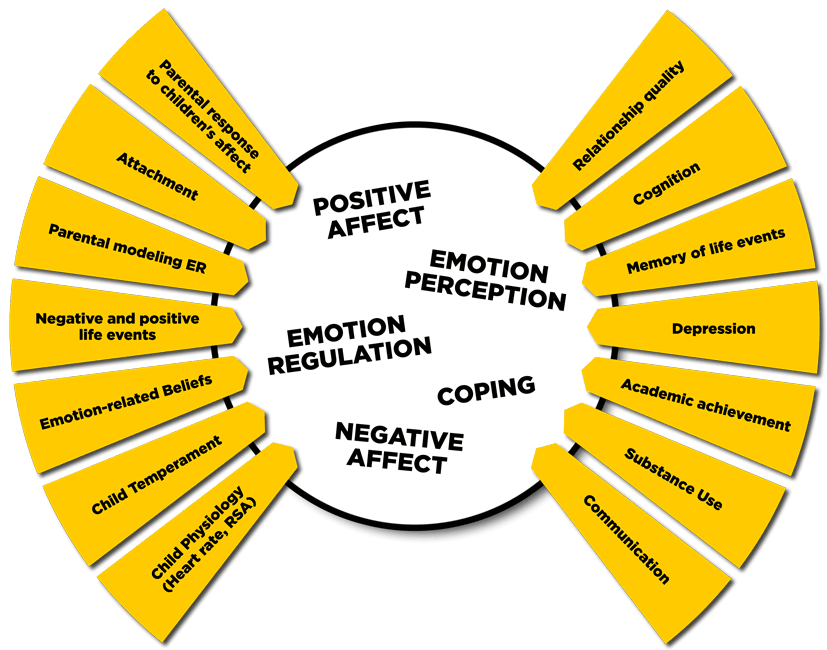
In the IDEA Lab, we study people’s emotional lives. A unique focus of the lab is our research on positive affect regulation and how people think about and seek out happiness. We also try to better understand how and why people develop the emotion beliefs or regulatory strategies that they do by studying factors like attachment, family socialization, and history of depression. For the last ~15 years, we have examined social media use to investigate how different platforms meet people’s social or emotional needs and associations with mental health in adolescents.
Areas of Research
- Social Media Use in Teens, College Students, and Families – Like with other topics, we often take an individual differences approach to determine why people use particular platforms/modes of communication or why they react differently to the same platforms.
- At the 2025 SRCD conference, grad student Kimia Izadinia presented
 about risk and protective factors associated with high school teens’ social media use.
 - In an earlier paper, we found that extraverted teens do not report elevated depressive symptoms when using Instagram frequently, whereas teens low or average on extraversion do have higher depressive symptoms with frequent Instagram use (Gentzler et al, 2023).
- At the 2025 SRCD conference, grad student Kimia Izadinia presented

- Undergraduate Imalay Ruiz presented at the WV Capitol in 2025 about how teens’ rates of social media addiction was related to their attachment to their parents. Boys who were more anxiously attached to their fathers reported more problematic social media use.
- In prior work, we found that more anxiously attached college students reported more higher quality romantic relationships when they communicated with partners more often on social media. However, for more avoidantly attached college students, texting with their partner was related to higher quality relationships, potentially because they can better control the frequency and emotional intimacy compared to in-person communication (Morey et al., 2013).
- Positive Emotion Regulation – What do people do (after good things happen or how do they seek happiness) and what are ramifications of these behaviors?
- The pursuit of happiness and well-being. Happiness is considered one of the most important aspects of life (and parents’ # 1 wish for their children), yet we do not know a lot about the pursuit of it. Despite many benefits to feeling good (Fredrickson, 1998; Lyubomirsky et al., 2005; Ramsey & Gentzler, 2015), if people prioritize their own happiness too much, it can be problematic (Mauss et al., 2011). We published findings from 3 studies indicating that youth who excessively value their happiness report higher levels of depressive symptoms (Gentzler, Palmer, Ford, Moran, & Mauss, 2019). We also are
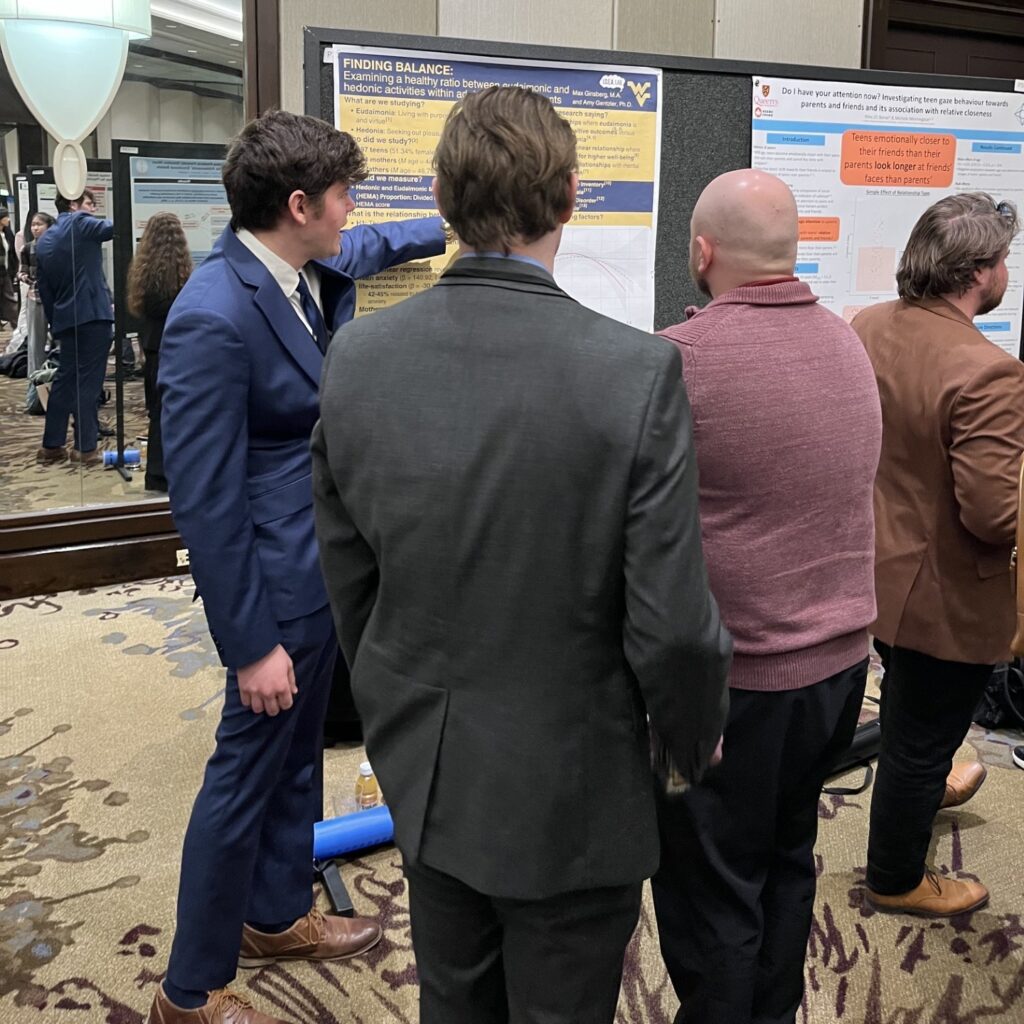 investigating teens’ pursuit of hedonic and eudaimonic wellbeing in a NIH-funded study with collaborators: Amy Root, Christa Lilly, Iris Mauss, Alfgeir Kristjansson, and Veronika Huta. At the 2026 SAS conference, grad student Max Ginsberg presented on importance of a balance of these pursuits.
- The pursuit of happiness and well-being. Happiness is considered one of the most important aspects of life (and parents’ # 1 wish for their children), yet we do not know a lot about the pursuit of it. Despite many benefits to feeling good (Fredrickson, 1998; Lyubomirsky et al., 2005; Ramsey & Gentzler, 2015), if people prioritize their own happiness too much, it can be problematic (Mauss et al., 2011). We published findings from 3 studies indicating that youth who excessively value their happiness report higher levels of depressive symptoms (Gentzler, Palmer, Ford, Moran, & Mauss, 2019). We also are
-
- Measurement work. We developed surveys to assess how people respond to positive events. The initial survey (the PEARS/Positive Events And Responses Survey; Gentzler, Palmer, & Ramsey, 2016) includes vignettes and assesses participants’ likelihood of responding in various ways. There are versions for adults (PEARS-A; Ramsey & Gentzler, 2014) and youth (PEARS-Y). Researchers can analyze broader scales – either savoring and dampening (Ramsey & Gentzler, 2014) or natural savoring, intentional savoring, and dampening (Gentzler et al., 2016; Palmer & Gentzler, 2019). Subscales can also be analyzed on their own, such as just examining bragging (Palmer, Ramsey, Morey, & Gentzler, 2016), reflection, gratitude, etc. We also created a version (PAARS) without vignettes that asks about participants’ responses to positive affect rather than specific positive events.
- Development of Emotion Regulation – What factors might contribute to individual or group differences in ER?
- Beliefs about emotions. We have been studying how people think about emotions as a predictor of emotion socialization, emotion regulation, and adjustment.
 At SRA in 2024, graduate student, Jeanie Pool, presented on how ER explained links between emotion beliefs and anxiety. In another study, we applied affect valuation theory (Tsai, 2007) to mothers’ positive emotion socialization. We found that mothers who want their child to feel more high-arousal positive emotions (excitement, etc.) are more likely to encourage behaviors (celebrating) likely to elicit those emotions, whereas mothers who want their child to feel low-arousal positive emotions encourage different behaviors (e.g., affection; Gentzler, Palmer, Yi, Root, & Moran, 2018). In Jennifer Morey’s dissertation, she found that parents who have more positive beliefs about emotions (meta-emotion philosophy) are more accurate in reading children’s emotions expressions and have more desire to interact with children (Morey & Gentzler, 2017).
- Beliefs about emotions. We have been studying how people think about emotions as a predictor of emotion socialization, emotion regulation, and adjustment.
-
- Attachment style. Children’s early relationship with their parents/caregivers teaches them if they can rely on others for support and intimacy, and how to regulate attachment needs and emotions accordingly. We found that children who are more securely attached to their fathers report more savoring of positive life events (Gentzler, Ramsey, Yi, & Palmer, 2014). Mothers who report more avoidant attachment report feeling less positively and encouraging less savoring when their children experience positive events (Gentzler, Ramsey, & Black, 2015). In older adults, Palmer and Gentzler (2018) found that more insecurely attached adults (more avoidant or more anxious) did not benefit from savoring interpersonal positive events like other adults who are more secure.
-
- Parent socialization. Parents/caregivers have a major influence on children’s developing emotion regulation. We often study it in the context of positive affect and what children might be learning about how to react to positive events in their lives and how to react to and seek out positive feelings. We edited a quartet of papers for Social Development on parent socialization of children’s positive affect regulation and published an integrative paper discussing next steps for this research (Gentzler & Root, 2019).
- Emotion Regulation in Particular Populations
- Emotion regulation and related attitudes and abilities in actors. As part of a collaborative project with Roger Smart, we investigated actors’ emotion beliefs and abilities. Given how integral emotions are to acting, we expected that theatre majors may have a greater emotion understanding and more skills (emotion perception, awareness, regulation, etc.) compared to college students with no acting background. We found some support for our hypotheses (Gentzler, DeLong, & Smart, 2019).
-
- Emotion regulation in parents. Given that parenting can be challenging and full of emotionally-evocative situations, parents’ regulation is critically important. For example, Tyia Wilson investigated how parents and adolescents’ emotion regulation predicts parents’ happiness. Former undergraduate Kaley Morrow found mothers with elevated depressive symptoms are more likely to dampen their own positive emotions, and are less likely to savor their own or their child’s positive emotions or events.
-
- Emotions in older adults. Former students, Cara Palmer and Megan Ramsey, completed studies on how people’s positive emotion regulation varies with age. Ramsey and Gentzler (2014) found that, contrary to expectations, older adults did not report more savoring than middle-aged and younger adults and savoring did not account for older adults’ higher levels of well-being. Palmer and Gentzler (2019) advanced this research using an experiment to show that older adults savor less than middle-aged and young adults, and that older adults’ emotional goals (desiring less high-arousal positive affect and lower motivation to pursue hedonia) can explain their lower tendency to savor or to benefit from savoring.